

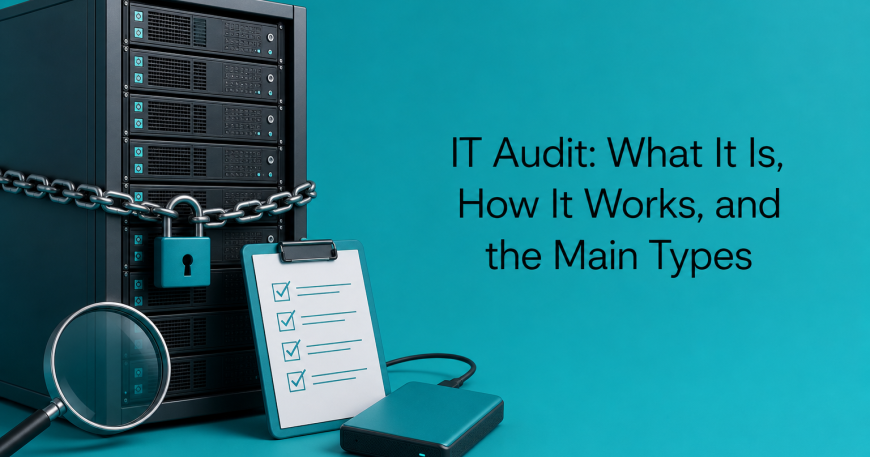
What is IT audit? It is an independent, structured examination of an organization’s information systems to check that they are secure, reliable, and well controlled. An auditor collects evidence, tests it against a standard or policy, and reports what works, what does not, and what to fix.
A financial audit checks the numbers. An IT audit checks the systems that produce those numbers, along with the data, user access, networks, software changes, and backups behind them. If a loan system lets one person create and approve the same loan, the financial statements may look fine until the day they do not.
This article explains why an IT audit matters, how the process runs from planning to follow-up, what auditors actually examine, and the main types you will meet. It ends with a practical preparation checklist. At RKCO East Africa Consulting, we carry out information systems audits and internal audits for organizations in Kenya, Uganda, and Tanzania, so the focus here is on what you can use, not on theory.
Why an IT audit matters
An IT audit matters because nearly every financial figure, customer record, and management decision now depends on systems that can fail, be misused, or be attacked. The audit tells you where the weaknesses are before they cost you money or reputation.
It protects money and data
Most losses linked to IT come from ordinary control gaps, not exotic attacks. Examples are former staff whose accounts still work, developers who push changes straight into live systems, and backups that nobody has ever restored. Take a SACCO whose core banking system lets one officer create and approve a loan. That is a segregation of duties failure, and it is exactly what an auditor looks for. An audit also tests whether you could recover from ransomware or a system failure, not only whether you have a backup policy on paper.
It supports compliance and trust
Financial auditors, regulators, lenders, and boards all want evidence that your systems can be trusted. External auditors rely on your IT controls when they sign off the accounts. In Kenya, the Data Protection Act, 2019 also requires organizations that handle personal data to protect it, and regulated entities such as banks and SACCOs face supervisory expectations on IT risk. An audit report gives you documented evidence of control that you can show to all of these parties.
A good audit gives you three practical outputs:
- A clear picture of your current control strength.
- A ranked list of findings, so you fix the serious gaps first.
- Evidence for your board, audit committee, and regulators.
An IT audit does not prove your systems are safe. It shows you, with evidence, where they are not.
How an IT audit works step by step
An IT audit follows a fixed sequence: plan, understand, assess risk, test, report, and follow up. The details change with the audit type, but the sequence rarely does.
The six stages
- Planning and scoping. You and the auditor agree on objectives, systems in scope, time period, and the standard to audit against.
- Understanding the IT environment. The auditor reviews your IT structure, key applications, recent changes, incidents, and ongoing projects. This is refreshed at every audit.
- Risk assessment. The auditor decides which systems and processes carry the highest risk and puts the most effort there.
- Control testing. The auditor interviews staff, inspects configurations, reviews logs, and tests samples to see whether controls exist and work in practice.
- Reporting. Findings are rated by severity, with the cause, the risk, and a recommended fix. Management responds with action plans and dates.
- Follow-up. The auditor verifies that agreed fixes were made. Serious findings are often rechecked sooner than the next scheduled audit.
A worked example: user access review
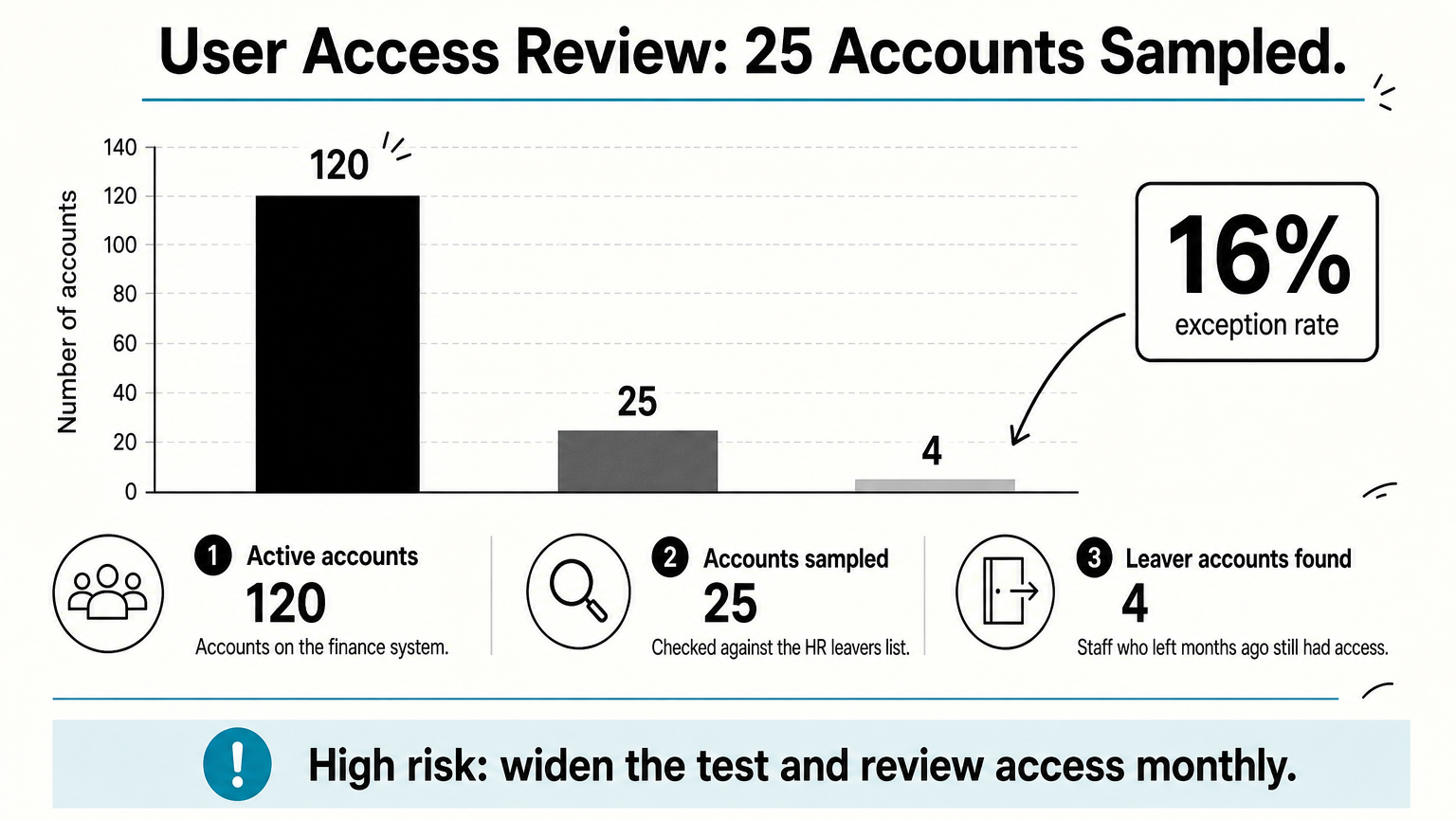
Suppose a company has 120 active accounts on its finance system. The auditor requests the HR leavers list and the user list, then samples 25 accounts. Four of the 25 belong to staff who left months ago. That is a 16% exception rate, so the auditor widens the test, rates the finding as high risk, and recommends a monthly access review owned by HR and IT together. This is the typical pattern: sample, find an exception, trace the cause, and recommend a control that stops it recurring.
Auditors test whether controls work in practice, so a policy that nobody follows counts as a gap.
What an IT audit examines
An IT audit examines the controls that govern your systems, grouped mainly into general controls that apply across the environment and application controls built into specific systems. Scope depends on your size, your sector, and why the audit is happening.
The main control areas
| Area | What the auditor checks | Typical test |
|---|---|---|
| Access management | Who can reach systems and data, and with what rights | Compare user lists to leavers and role approvals |
| Change management | How software and system changes are requested, tested, approved, and released | Trace a sample of changes to approvals and test evidence |
| IT operations | Backups, job scheduling, monitoring, incident handling | Review backup logs and a restore test |
| Application controls | Automated checks inside a system, such as approval limits and calculations | Re-perform a calculation or try an invalid entry |
| Security | Network protection, patching, encryption, endpoint controls | Review configurations and patch status |
| Data and reports | Completeness and accuracy of key reports | Compare a report to source data |
| Development projects | Design, testing, and go-live of new systems | Review project approvals and user acceptance testing |
General controls and application controls
General IT controls are similar from one organization to the next. They cover access, changes, operations, and development. Application controls are specific to each system, for example a rule that blocks a payment above a user’s approval limit. Auditors usually test general controls first, because weak general controls undermine confidence in everything built on top of them.
Standards auditors measure against
An audit needs criteria. Common ones are ISO/IEC 27001 for information security management, the COBIT framework for IT governance, and regulations such as the Sarbanes-Oxley Act for listed companies in the United States. Auditors also test against your own policies. If you want to build this skill in-house, RKCO offers an ISO 27001:2022 Lead Auditor course at KES 70,000.
The standard you audit against defines the scope, so choose it before the audit starts.
Main types of IT audit
IT audits are classified by who performs them and by what they aim to achieve. The same engagement often fits more than one label, so it helps to know each one.
By who performs the audit
| Type | Performed by | Main purpose |
|---|---|---|
| Internal audit | Your own staff or an outsourced internal audit team | Find risks, improve controls, support governance |
| External audit | Independent auditors, often during the financial audit | Decide whether IT systems and data can be relied on for the accounts |
| Second-party audit | A customer or partner auditing a supplier | Confirm the supplier meets contract requirements |
| Third-party audit | An independent body free of conflict of interest | Certification or formal assurance, such as against ISO 27001 |
Internal audits are done on your own initiative. External audits are driven by the financial audit team’s plan, and a less mature IT environment may only receive an understanding review without detailed control testing.
By purpose and technique
A compliance audit checks conformance to a regulation, standard, or policy. A performance audit asks whether systems work efficiently and deliver value, which goes beyond a pass or fail. Both rely on the same evidence-gathering methods.
Some specialist engagements sit next to the traditional audit. Penetration testing simulates real attacks to find exploitable weaknesses, while an audit tests controls and governance. Forensic investigation looks into a suspected incident or fraud after the fact. Many organizations combine them, with an audit finding the control gap and a penetration test showing how an attacker could use it.
An audit reviews your controls, while a penetration test attacks them. You usually need both.
How to prepare for your first IT audit
Preparation comes down to knowing your systems, having your evidence ready, and assigning owners to answer questions. Organizations that do this finish audits faster and with fewer surprises.
Before the auditors arrive
Work through this checklist:
- List your systems. Include core applications, databases, servers, cloud services, and who owns each.
- Gather your policies. Access control, change management, backup, incident response, and data protection.
- Run an access review. Remove leavers, check privileged accounts, and confirm approvals exist.
- Test a backup restore. Keep the evidence of the result.
- Collect change records. Approvals and test results for recent system changes.
- Name a contact for each area so questions reach someone who can answer them.
During and after the audit
Answer questions honestly and provide evidence rather than explanations. A finding you already know about, with a plan attached, is far less damaging than one the auditor discovers alone. When the report arrives, assign each action an owner and a date, and check progress monthly rather than waiting for the follow-up audit.
If your team lacks time or specialist skills, an outside firm can run the audit or help you prepare. Your options include an internal audit partner, an information systems audit, or a readiness review ahead of an ISO certification audit.
The best audit preparation is a routine of access reviews, change records, and restore tests that runs all year.
Where to start with your own IT audit
An IT audit is an independent check that your systems are secure, reliable, and controlled, done through planning, risk-based testing, reporting, and follow-up. Whether it is internal, external, or a certification audit, the value comes from acting on the findings.
Start small. List your critical systems, review who has access, and confirm you can restore a backup. If you want an experienced team to scope, run, or support an audit, you can talk to RKCO East Africa Consulting about an information systems audit.
