

Description
Description of the Quality Assurance and Improvement Program (QAIP)
Purpose
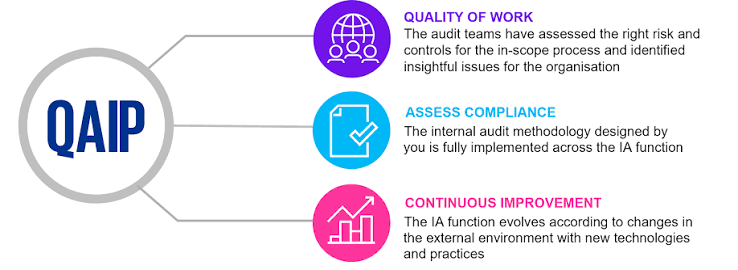
The Quality Assurance and Improvement Program (QAIP) is a structured program, maintained by the Chief Audit Executive (CAE), that covers every aspect of the internal audit function. Its purpose is to give the Board, the Audit Committee and senior management reasonable assurance that internal audit:
- conforms with the Global Internal Audit Standards, the Code of Ethics and the Internal Audit Charter;
- achieves its performance objectives and adds value to the organisation; and
- continually improves its processes, people and results.
The Global Internal Audit Standards require the CAE to develop, implement and maintain a QAIP (Standards 8.3 and 12.1 to 12.3). The program is therefore both a compliance requirement and a management tool for assessing how effective internal audit is.
Scope
The QAIP applies to all internal audit activities: audit planning, engagement execution, reporting, follow-up, governance of the function, resource management and professional conduct. It covers assurance and advisory work, whether performed by in-house staff or by co-sourced or outsourced providers.
Components of the program
1. Ongoing monitoring (internal assessment). This is the day-to-day review of work as it is performed. It includes supervisory review of work programs and working papers, engagement checklists, pre-issuance review of reports, tracking of time and budgets, and feedback from auditees. It catches quality issues early, before a report is issued.
2. Periodic self-assessment (internal assessment). At least annually, the CAE or an independent QA lead assesses the whole function against each Standard. The assessment samples completed engagements, reviews policies and methodology, and rates conformance as Generally Conforms, Partially Conforms or Does Not Conform. Gaps are recorded with the evidence behind them.
3. Performance measurement. Key performance indicators show whether internal audit is efficient and effective. They cover:
- plan completion;
- timeliness of reports;
- budget variance;
- recommendations accepted and implemented;
- repeat findings;
- stakeholder satisfaction; and
- staff development.
Actual results are compared with set targets each quarter.
4. Stakeholder feedback. The Board or Audit Committee, senior management and auditees are asked how well internal audit meets their expectations. This shows whether the function’s work is seen as relevant, objective, timely and useful.
5. External quality assessment. At least once every five years, a qualified and independent assessor evaluates conformance with the Standards. This can be a full external assessment or a self-assessment with independent validation. The Board or Audit Committee oversees this assessment together with the CAE.
6. Reporting. The CAE reports to the Board and senior management at least annually on:
- results of internal and external assessments;
- the level of conformance;
- improvement plans and progress; and
- any non-conformance, including its effect on the scope or operation of internal audit.
7. Continuous improvement. Every gap or weakness is logged in an action plan with a root cause, a corrective action, an owner, a due date and a status. Progress is reviewed regularly, and overdue or high-priority items are escalated.
Roles and responsibilities
| Role | Responsibility |
|---|---|
| Board / Audit Committee | Approves the Charter, oversees the QAIP, receives results, and commissions the external assessment |
| CAE | Owns the QAIP, ensures its implementation, reports results, and is accountable for improvement actions |
| Audit managers and supervisors | Perform ongoing monitoring and supervisory review of engagements |
| Internal auditors | Follow the methodology, document their work, and take part in self-assessments |
| External assessor | Provides an independent opinion on conformance and effectiveness |
How effectiveness is evaluated
The program produces an overall QAIP score from four inputs:
- ongoing monitoring conformance;
- self-assessment conformance with the Standards;
- the percentage of KPIs met; and
- stakeholder satisfaction.
Each input carries a weight, and the weighted total is converted into a rating of Generally Conforms, Partially Conforms or Does Not Conform. A rating of Generally Conforms means internal audit is effective and meets the Standards. A lower rating triggers corrective actions and heightened reporting to the Board.
Expected outcomes
- Greater confidence in internal audit’s reliability and credibility.
- Consistent, high-quality engagements.
- Early detection and correction of weaknesses.
- Demonstrated value to stakeholders.
- A culture of continuous improvement in methodology, skills and technology.