


A forensic investigation audit, usually just called a forensic audit, is a detailed examination of an organization’s financial records and transactions to establish whether fraud or other financial misconduct occurred, who was behind it, how much it cost, and what evidence proves it. Unlike a routine audit, it starts from a specific suspicion or allegation. It produces findings that can stand up in court, before a regulator, or in an insurance claim.
The terms around it get mixed up. "Forensic audit," "forensic investigation," and "forensic accounting" overlap but are not identical, and a forensic auditor is not the same role as your external auditor. This article covers why a forensic audit matters, how the process runs from first suspicion to final report, the main types, how long it takes, and how it differs from a traditional audit and from forensic accounting.
At RKCO East Africa Consulting, forensic audit and investigation sits next to internal audit, IT audit, and governance, risk, and compliance work for organizations in Kenya, Uganda, and Tanzania. What follows is the practical view of that work, so you can judge when you need one and what to expect.
Why a forensic audit matters for your organization
A forensic audit matters because it answers the questions a normal audit cannot: what happened, who did it, how much was lost, and what proof exists. For a SACCO, a school, or a manufacturer, that decides whether you can recover money and discipline staff or only suspect that something is wrong.
A forensic audit turns a suspicion into evidence that you can act on.
The objectives of a forensic audit
The objectives of a forensic audit are narrower and more practical than those of a financial audit. The work is scoped around one allegation, and it has to produce evidence, not opinions about the books as a whole. A typical engagement sets out to:
- Establish whether a fraud or irregularity actually took place.
- Identify the type of scheme, how long it ran, and how it was hidden.
- Identify the people involved, and whether they colluded.
- Quantify the financial loss.
- Gather evidence that a court, regulator, or insurer will accept.
- Recommend control fixes so the same scheme cannot repeat.
The last objective is easy to overlook. A report that proves a theft but leaves the weak control in place only buys you a second theft.
Warning signs that call for a forensic audit
You rarely need a forensic audit because of one odd number. You need one when several small signals point the same way, or when a tip lands on the desk of your board or audit committee. Common triggers include:
- Stock or cash shortages that nobody can explain.
- Suppliers with no physical address, or whose bank account matches an employee’s.
- Payroll headcount that differs from HR records.
- A staff member who never takes leave and resists handing over duties.
- Reconciliations that are always late or always "adjusted."
- Journal entries posted just before period end with thin support.
- A whistleblower report or a complaint from a member, customer, or supplier.
If two or three of these appear together, stop and get advice before anyone asks the suspect questions.
Who a forensic auditor is and what they do
A forensic auditor is a professional who combines accounting, auditing, and investigative skills to examine records for evidence of fraud. Most are qualified accountants, such as a CPA-K, with specialist training in fraud techniques, interviewing, and keeping evidence in a form a court will accept. The work often involves a team that includes IT specialists and lawyers.
The role has a firm limit. A forensic auditor reports facts, amounts, and methods. They do not declare someone guilty, because guilt and intent are for the court to decide. That restraint is what keeps the findings credible when a defense lawyer attacks them.
How a forensic audit works from start to finish
A forensic audit follows the same skeleton as any audit: planning, evidence gathering, review, and a report. The difference is that every step is designed to survive legal challenge. You can expect seven stages, though the order shifts with the case.
Every step of a forensic audit is built so the evidence survives a challenge in court.
The seven stages of the forensic audit process
- Acceptance and scoping. The firm checks it has the right skills, confirms it is independent of the people involved, and agrees the scope in an engagement letter.
- Planning. The team defines the allegation, the period under review, the records needed, and the tools, such as data analytics.
- Securing evidence. Records, devices, and system logs are preserved before anyone can alter them, and a chain of custody is started.
- Analysis. The team tests controls, compares trends, reconciles accounts, and mines transaction data for patterns.
- Interviews. Staff are interviewed, and the suspect is usually interviewed last, once the evidence is strong.
- Reporting. The report sets out the scheme, the evidence, the loss, and the controls that failed.
- Follow-up. The team supports recovery, disciplinary action, or court proceedings, including testimony if required.
Gaps in the chain of custody are the most common way good evidence becomes useless. If nobody can show who held a document or device and when, a court may refuse to admit it.
A worked example: ghost employees on a payroll
Take a SACCO whose payroll lists 120 names while HR records show 117 staff. The forensic team matches payroll lines to HR files and bank accounts, then finds three "employees" paid into accounts linked to one payroll clerk. Each is paid KES 45,000 a month, and the scheme ran for 18 months.

The quantified loss is 3 × KES 45,000 × 18 = KES 2,430,000. That figure, the account trail, and the system logs showing who created the records are what the report puts in front of the board. The recommended fix is a separate sign-off between payroll changes and payroll payment.
How long a forensic audit takes
There is no standard forensic audit time frame. A narrow review of one account may take a few weeks, while a multi-year, multi-branch case with digital evidence can take several months. The main factors are:
- The volume of records and the number of years covered.
- The number of branches, accounts, or systems involved.
- How quickly the organization provides complete records.
- Whether electronic devices need to be imaged and analyzed.
- Whether the matter is heading to litigation, which adds report and testimony work.
Ask for an estimate by stage, not a single end date. Findings in the early stages often change the scope.
Types of forensic audit
Forensic audits are best grouped by the kind of misconduct under investigation, then by timing. Three fraud categories cover most cases: corruption, asset misappropriation, and financial statement fraud. Asset misappropriation is by far the most common, and corruption features in roughly one third of frauds.
Knowing the fraud category tells you which records to pull and which tests to run first.
Types by the kind of fraud
| Category | What it involves | Typical example |
|---|---|---|
| Corruption | Conflicts of interest, bribery, extortion | A manager approves a friend’s inflated expense claims |
| Asset misappropriation | Theft or misuse of cash and other assets | Fictitious suppliers, ghost employees, stolen inventory |
| Financial statement fraud | Deliberate misstatement of reports | Hiding liabilities to make liquidity look stronger |
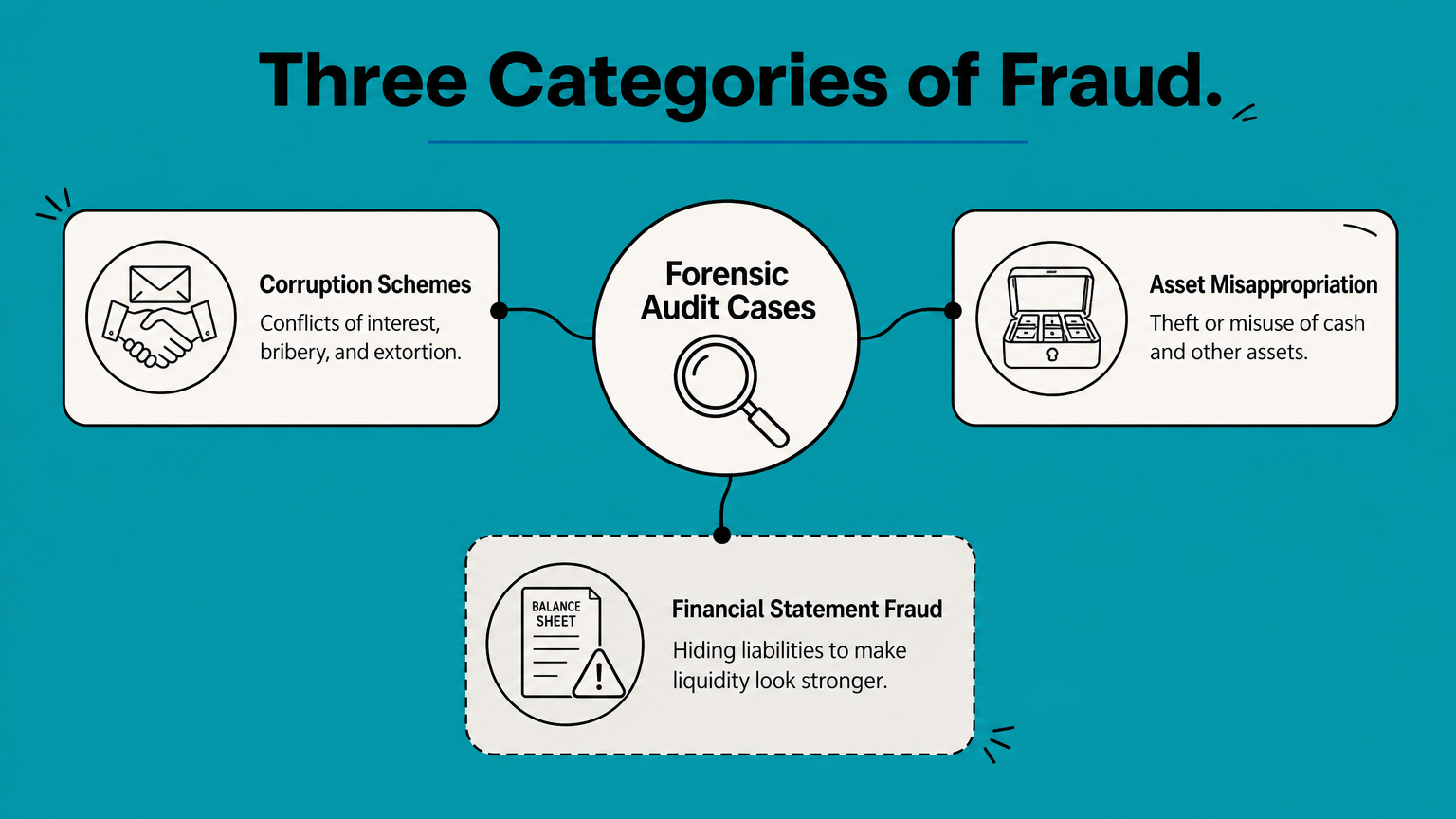
Each category leaves different traces. Billing schemes show up in vendor master files, while financial statement fraud shows up in journal entries, estimates, and disclosures.
Reactive and proactive forensic audits
A reactive forensic audit follows an allegation or suspicion, and this is the type most people mean. A proactive one is carried out with no allegation on the table, to look for hidden irregularities and test whether your controls would catch fraud. Proactive work is common in high-risk areas such as procurement, payroll, and cash handling.
Both use the same techniques. The difference is the trigger and the starting point. A reactive audit begins with a known target, while a proactive audit begins with risk areas and data patterns.
Digital and non-fraud engagements
Many frauds now leave their main evidence in systems, so digital forensics is often part of the work. That includes recovering deleted files, tracing changes to system records, and analyzing emails and mobile money logs. Specialists handle this to keep the evidence admissible.
Forensic skills are also used outside fraud. They help settle monetary disputes after a business closure, quantify insurance claims, and support commercial or matrimonial disputes. The method is the same: neutral evidence, clear quantification, and a report a third party can rely on.
Forensic audit vs traditional audit and forensic accounting
A traditional audit asks whether the financial statements are fairly presented. A forensic audit asks whether specific transactions are truthful, and who is responsible if they are not. Forensic accounting is the wider field that contains forensic audit, not a competing service.
A traditional audit gives an opinion on the statements, while a forensic audit builds a case on one allegation.
Audit vs forensic audit
| Aspect | Traditional financial audit | Forensic audit |
|---|---|---|
| Purpose | Opinion on whether statements are fairly presented | Find and prove misconduct, quantify loss |
| Trigger | Routine, often required by law | A suspicion or allegation |
| Scope | Whole financial statements, sampling | One incident or area, in depth |
| Materiality | Uses a materiality threshold | Not limited by materiality |
| Evidence standard | Reasonable assurance | Court-ready evidence |
| Output | Audit opinion | Detailed findings and evidence report |
| Frequency | Recurring | Unplanned, one-off |
The materiality row is the one that surprises people. An auditor cannot test every transaction, so a small theft can sit below the threshold. A forensic auditor follows even a small amount if it leads to the scheme.
Forensic audit vs forensic accounting
Forensic accounting describes the whole process of investigating a financial matter, including acting as an expert witness. The forensic investigation is the practical set of steps that gathers evidence. The forensic audit is the specific audit procedures used to produce that evidence, such as testing controls and reconstructing transactions.
In everyday use, people treat the three as interchangeable, and providers often do. When you write a scope of work, though, state which deliverable you need: an investigation report, a quantified loss, expert testimony, or all three.
Why your external auditor will not catch everything
Many boards assume the annual audit would have found a fraud. It was never designed to. Under the International Standards on Auditing, primary responsibility for preventing and detecting fraud rests with management and those charged with governance, and the auditor works to obtain reasonable assurance about material misstatement. A financial audit can flag a fraud, but it does not promise to find one.
How to commission a forensic audit in Kenya
To commission a forensic audit well, protect the evidence first, bring in legal counsel early, and hire an investigator who is independent of the people and systems involved. The first days after a suspicion decide how strong your case will be.
What you do in the first week decides whether the evidence survives later.
Steps to take before the forensic team arrives
Resist the urge to investigate on your own. Well-meant questions and file searches often alert the suspect or alter the evidence. Instead:

- Limit knowledge of the matter to a small group, such as the board chair and audit committee.
- Preserve records, laptops, phones, and system logs, and do not edit or "clean up" files.
- Restrict access for the suspected person quietly, with legal advice on how.
- Do not confront the suspect before the evidence is gathered.
- Involve your lawyer early, since work directed through counsel may be privileged.
- Check your reporting duties to your regulator, for example if you are a SACCO or other regulated entity, and notify your insurer if you have fidelity cover.
Choosing the right forensic auditor
Look for a practitioner with fraud investigation experience, relevant professional credentials such as CPA-K and membership of bodies like ICPAK, and a record of presenting findings in legal settings. Independence matters. A firm that audits your accounts should not also run your forensic investigation unless strong safeguards are in place, because of the risk of reviewing its own work.
Before signing, confirm the engagement letter defines the scope, the period, confidentiality, and how evidence will be held. Beware of anyone who promises a particular outcome. A credible firm cannot guarantee findings. RKCO East Africa Consulting offers forensic audit and investigation with evidence-based findings, alongside internal audit and IT audit, which helps when a case has both financial and digital strands.
What happens after the report
The report is the start of your decisions, not the end. You can pursue recovery, discipline, or a referral to law enforcement, such as the Directorate of Criminal Investigations, or the Ethics and Anti-Corruption Commission where corruption is involved. Take legal advice on the route and on how Kenyan courts treat electronic evidence.
Then close the gap. Implement the recommended controls, track them to completion, and report progress to the board. That is how a forensic audit pays for itself.
Putting a forensic audit to work
A forensic investigation audit is a focused, evidence-first examination that finds out whether fraud happened, who was involved, and what it cost. It differs from a traditional audit in trigger, scope, and standard of proof, and it sits inside the wider field of forensic accounting. Its value comes from method: secure the evidence, follow the money, quantify the loss, and fix the control that failed.
If you suspect fraud or want to test your controls before it happens, act early and keep the circle small. You can talk to RKCO East Africa Consulting about a forensic audit and get a clear view of scope and next steps.
