


The differences between internal and external audit come down to who does the work, who it is for, and what it checks. An internal audit is done by your own staff or an outsourced team that reports to management and the board. It tests whether controls, risks, and processes work. An external audit is done by an independent firm, usually certified public accountants. It gives outsiders such as lenders, regulators, and members an opinion on your financial statements or compliance.
This guide sets the two side by side. You will see why the distinction matters, how to tell internal audit and external audit apart on the points that count, how the two support each other, and how to decide what your organization needs.
RKCO East Africa Consulting provides internal audits, information systems audits, and forensic audits to organizations across East Africa.
Why the difference between internal and external audit matters
It matters because each audit answers a different question for a different audience, so one cannot stand in for the other. Confuse them and you either leave control weaknesses unexamined or hand outsiders a report they will not trust.
What goes wrong when you mix them up
The most common mistake is assuming the annual external audit will find your control problems. It will not, at least not fully. An external auditor plans the work to form an opinion on whether the financial statements are free of material misstatement. That is a narrower job than testing every process, and it gives reasonable assurance, not a guarantee that every error or fraud is found.
The reverse mistake is just as costly. Management sometimes hands an internal audit report to a lender or regulator and expects it to carry weight. It will not, because the authors work for the audited organization. Outsiders want an independent opinion, and only an external audit provides one.
An external audit tells outsiders whether to trust your numbers, and an internal audit tells you how to deserve that trust.
Who relies on each audit
The readers of each report show the gap fastest. Internal audit serves the people who run and oversee the organization. External audit serves the people looking in from outside.

- Internal audit readers: the audit committee, the board, senior management, and the owners of the audited process.
- External audit readers: shareholders or SACCO members, lenders, regulators, donors, and in some cases customers who ask for assurance reports.
How to tell internal and external audit apart
Check seven things: who performs the audit, why it exists, what it covers, who receives the report, what it produces, how often it happens, and whether the law requires it. The table below answers each one.
Who performs the audit and how independent they are
Internal auditors are employees of the organization, or an outsourced provider acting as its internal audit function. They stay objective by reporting to the audit committee instead of to the managers they audit, and by never auditing an area they run. Outsourcing does not turn an internal audit into an external one. The outsourced team still serves management and the board.
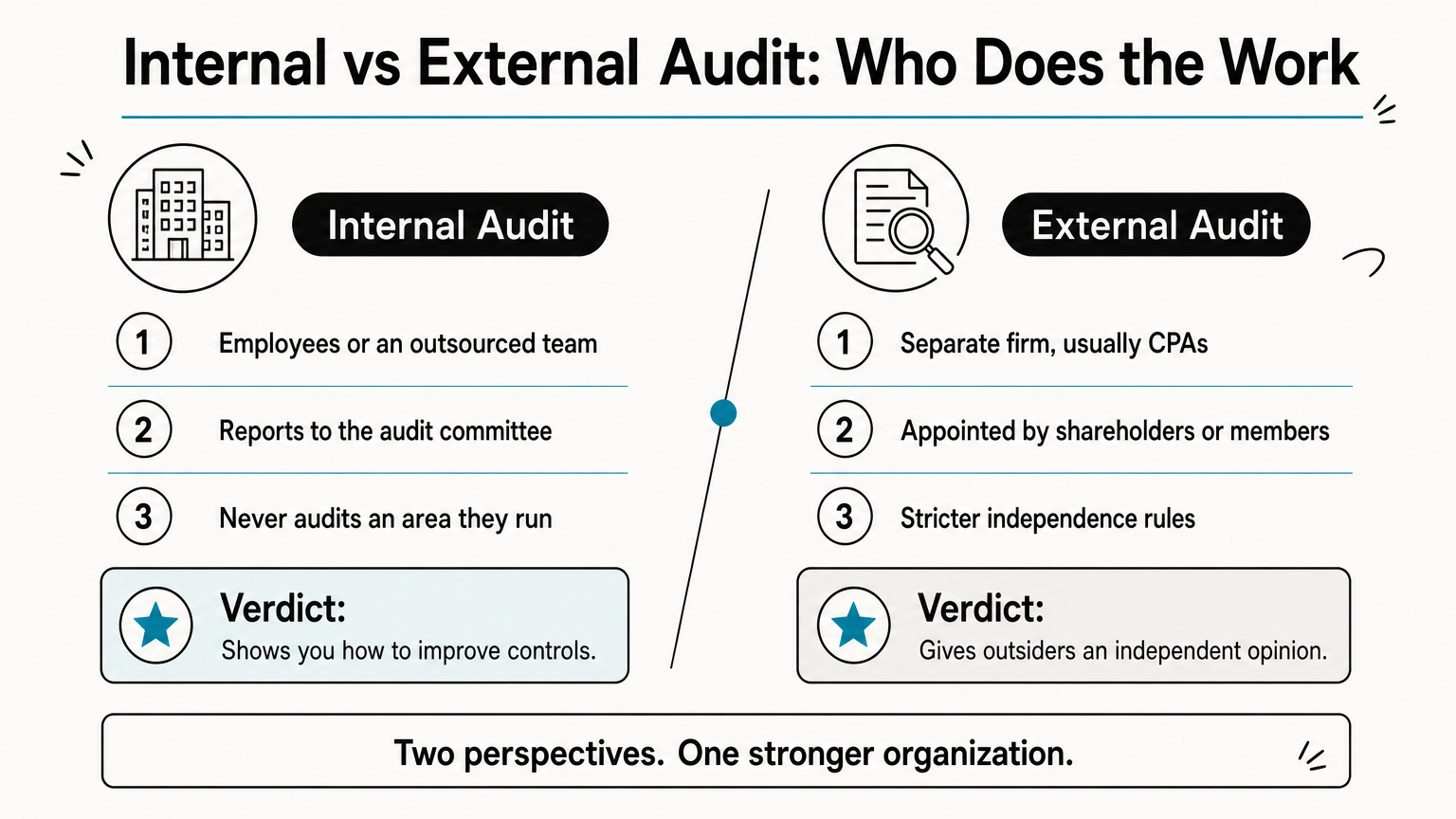
External auditors are a separate firm, usually of CPAs, appointed to audit the organization, often by its shareholders or members. Their independence rules are stricter. They cannot hold a management role, have a financial stake in the client, or provide services that compromise their objectivity.
Purpose, scope, and reporting side by side
This table compares internal audit vs external audit on the points most readers search for.
| Point | Internal audit | External audit |
|---|---|---|
| Performed by | Employees or an outsourced team working for the organization | An independent audit firm, usually CPAs |
| Main purpose | Improve controls, risk management, governance, and efficiency | Give an independent opinion on financial statements or compliance |
| Scope | Any process, department, system, or risk the audit plan selects | Set by law, auditing standards, and the engagement, mostly financial reporting |
| Standards | Institute of Internal Auditors (IIA) standards | International Standards on Auditing (ISAs), with IFRS or another reporting framework |
| Reports to | Audit committee and senior management | Shareholders or members, with the board and audit committee as day-to-day contacts |
| Output | Findings, risk ratings, recommendations, agreed management actions | Audit opinion plus a letter on control deficiencies |
| Frequency | Ongoing, on a risk-based plan, with high-risk areas reviewed yearly | Usually once a year |
| Required by law | Generally optional, though some regulated sectors expect one | Required for many companies and regulated bodies, and often demanded by lenders and donors |
What each audit produces
An internal audit report lists findings and recommendations, and management responds with action plans and deadlines. Internal audit then follows up to confirm the fixes happened. The report is mostly for internal use.
An external audit ends with an audit opinion. The opinion is unmodified (also called unqualified) when the statements are fairly presented. It is qualified, adverse, or a disclaimer when problems are material or the auditor could not get enough evidence. Auditors also send management a letter on the control weaknesses they noticed along the way.
Internal audit asks whether your controls work, and external audit asks whether outsiders can rely on your statements.
How internal and external audits work together
They work together because they share a method and overlap in what they test, and coordination saves time and fees for both.
What the two have in common
Both follow the same three phases and both depend on independence from the thing they examine. The overlap is wider than most people expect:
- Process: planning, fieldwork, and reporting.
- Access: unrestricted access to records, systems, and people.
- Evidence: conclusions backed by tested evidence, not opinion.
- Focus: both look at how well internal controls are designed and whether they operate.
How external auditors use internal audit work
The auditing standard on using the work of internal auditors (ISA 610) lets an external auditor rely on parts of that work. First they assess the internal audit team’s competence, objectivity, and quality of work. If the function is weak or reports to the people it audits, they will redo the testing themselves. Even when they rely on it, the external auditor stays fully responsible for the opinion.
Internal audit also helps before the external audit starts. A team that tests reconciliations, clears prior-year management letter points, and checks documentation gives the external auditors fewer surprises and fewer findings. That usually shortens fieldwork and lowers friction with finance staff.
The stronger your internal audit, the fewer surprises your external auditor can spring on you.
How to decide which audit your organization needs
Start with the question you need answered. If you need confidence in your own controls, you need internal audit. If someone outside demands assurance, you need external audit. Most organizations end up needing both.
Four questions to ask
- Does a law, regulator, lender, or donor require audited statements? If yes, an external audit is not optional.
- Are you worried about specific risks? Fraud, IT access, procurement, and cash handling call for internal audit, and sometimes a forensic or information systems audit.
- Can you staff an independent internal team? If not, outsource it, and keep reporting lines to the audit committee.
- Are you pursuing ISO certification? Then you need internal audits first and a certification body’s external audit after.
A worked example
Take a manufacturer with 10 key processes. A risk-based internal plan might review 3 high-risk processes every year (procurement, payroll, IT access), 4 medium-risk processes every 2 years, and 3 low-risk processes every 3 years. That is 3 + 2 + 1 = 6 internal audits a year, covering all 10 processes within a 3-year cycle. The external auditor still arrives once a year to opine on the statements, and can lean on the internal results.
ISO works the same way. ISO 9001 requires internal audits at planned intervals, while a certification body performs the external audit. RKCO supports this journey through its Bluestar Management Systems partnership with gap assessments, internal audits, and audit readiness. For staff who will run ISO audits themselves, RKCO lists ISO 14001:2015 and ISO 45001:2018 Internal Auditor options at KES 45,342 each, and Lead Auditor options at KES 71,252.
Match the audit to the question: controls you own call for internal audit, and assurance outsiders demand calls for external audit.
Using both audits well
Internal and external audits differ in who performs them, who reads them, and what they conclude, yet they share a method and strengthen each other. Internal audit improves your controls from within. External audit gives outsiders an independent opinion. Treat them as partners, with clear reporting lines and one coordinated calendar.
If you are unsure where your organization stands, a short review of your risks, regulators, and stakeholders will show which audit you need first. To discuss an internal audit plan, an IT or forensic review, or ISO readiness, talk to the RKCO East Africa Consulting team.
